Kendamil vs Enfamil Formula Comparison Guide
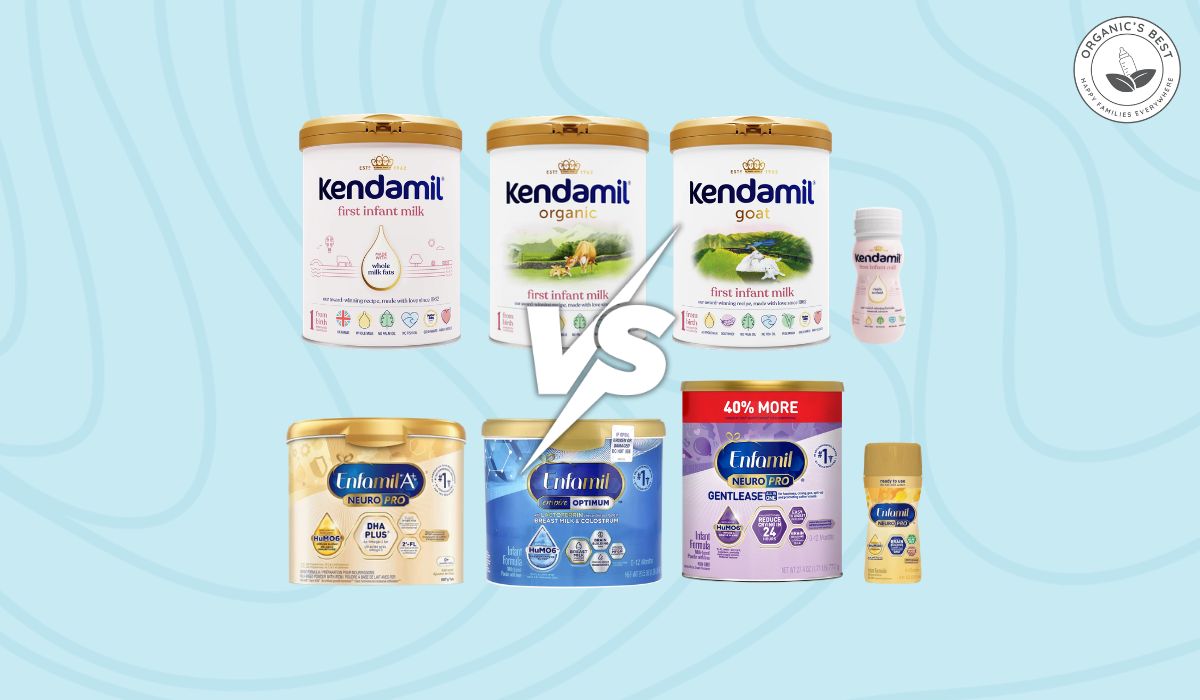

Modern parents are paying closer attention to what they are feeding their baby, and with so many formula options on the market, figuring out which one feels right for your family can take a lot of research. Between ingredient lists, online reviews, social media discussions, and advice from friends or pediatricians, it is easy to fall down a rabbit hole comparing brands.
Two formulas that come up constantly in those conversations are Kendamil and Enfamil. Kendamil has become one of the most talked-about European formulas among parents looking for whole milk-based recipes and simpler ingredient lists, while Enfamil has been a staple formula brand in North America for decades.
In this guide, we’ll walk through the biggest differences between Kendamil UK and Enfamil to help you better understand what sets them apart.
Table of Contents
- Enfamil vs Kendamil UK: American vs European Formula
- A Closer Look at Kendamil UK
- A Closer Look at Enfamil
- Kendamil Organic UK vs Enfamil Optimum Enspire Comparison
- Kendamil Classic UK vs Enfamil NeuroPro Infant Formula Comparison
- Kendamil Goat UK vs Enfamil NeuroPro Gentlease Comparison
- Kendamil Ready To Feed vs Enfamil NeuroPro Ready to Use
- Kendamil or Enfamil: Which Formula is Closer to Breast Milk?
- Quick Overview for Kendamil USA vs Enfamil
- Similarities and Main Differences Between Kendamil and Enfamil
- Kendamil vs Enfamil: Which Formula is the Right Choice for Your Little One?
- Final Thoughts on Kendamil Formula vs Enfamil
- FAQs on Kendamil vs Enfamil Formula Comparison
Enfamil vs Kendamil UK: American vs European Formula
One of the biggest differences between Kendamil and Enfamil is where and how they’re made, since European and US formula standards can differ.
Regulatory Standards: FDA vs EFSA
Kendamil and Enfamil are both tightly regulated, but they follow different governing systems.
Enfamil follows rules set by the U.S. Food and Drug Administration (FDA), while Kendamil UK follows standards set by the European Food Safety Authority (EFSA).
FDA Regulations in the United States
In the United States, the FDA regulates all infant formula products. They stipulate that American formulas must contain 30 essential nutrients, including protein, fats, vitamins, and minerals. The FDA also sets maximum limits for certain nutrients that can become harmful in excessive amounts, such as vitamins A and D.
Formula manufacturers in the U.S. must also:
-
Use ingredients that are approved food additives or considered Generally Recognized as Safe (GRAS)
-
Follow strict sanitation procedures during manufacturing
-
Test products for harmful bacteria like Salmonella and Cronobacter
-
Ensure the water used in production meets EPA safety standards
-
Continuously monitor nutrient levels based on updated scientific research

EFSA Regulations in the EU
European formulas like Kendamil follow regulations set by the European Food Safety Authority (EFSA), which are considered some of the strictest in the world.
Here are some of the notable guidelines set by the EFSA:
-
Precise minimum and maximum levels for key nutrients, including protein, fats, carbohydrates, vitamins, minerals, and essential fatty acids like DHA (which is required in EU formulas)
-
Strict limits on contaminants such as pesticides, heavy metals (like lead and cadmium), and process-related contaminants
-
Does not allow corn syrup as a carbohydrate source, requiring instead that at least 30% of carbohydrates come from lactose
-
Does not allow artificial sweeteners, colours, or preservatives
-
Restricts certain thickeners, flavouring agents, and genetically modified ingredients
-
Prohibits carageen in in infant formula products
-
If an ingredient is not explicitly approved, it cannot be included in the formula
More parents than ever are choosing European baby formulas because they meet these rigorous standards, in addition to the differences in ingredients and labelling.
A Closer Look at Kendamil UK
Kendamil is a family-owned British brand with more than 60 years of experience in infant nutrition. Their formulas are produced in their factory in England’s Lake District, an area known for its dairy farming and UNESCO World Heritage status, or in partner facilities across Europe to help meet demand.
By using whole milk as the primary fat source, Kendamil reduces the need for skim milk and added vegetable oils, resulting in a naturally creamy formula that has a similar composition to breast milk.
Each formula includes prebiotics that are intended to support gut health, plant-based DHA for brain and eye development, and a full range of essential vitamins and minerals for growth. Kendamil is also certified vegetarian and avoids ingredients like palm oil, fish oil, starch, maltodextrin, and soy.
The brand offers three main ranges:
-
Kendamil Classic Formula - The standard range, made with skimmed and whole cow's milk. Includes ready to feed version.
-
Kendamil Organic Formula - Whole and skim cow's milk formula made with certified organic ingredients under strict EU organic standards
-
Kendamil Goat Milk Formula - Made with whole A2 goat’s milk, which some babies tolerate well
A Closer Look at Enfamil
Enfamil is one of the most established infant formula brands in North America, with decades of research behind its products. It’s developed by Reckitt and manufactured in facilities that follow strict U.S. safety and nutritional standards. They offer a wide range of infant formulas based on cow's milk. The brand is built around clinically studied nutrition, with formulas designed to closely support growth, digestion, and early development.
A key feature across the Enfamil range is its focus on breast milk–inspired components. Many formulas include DHA and ARA for brain and eye development, naturally occurring MFGM (milk fat globule membrane) intended to support cognitive development, and prebiotics like GOS, intended to help support digestive health. Enfamil was also one of the first U.S. brands to include both DHA and MFGM in its infant formulas.
While we won’t be looking at every formula from the brand, we will compare some of their most popular options side by side to see how they compare, including:
-
Enfamil NeuroPro Infant - Everyday nutrition with DHA and MFGM for brain development. Includes Ready to Use format.
-
Enfamil NeuroPro Gentlease - Partially hydrolyzed proteins marketed to help with fussiness, gas, and crying
-
Enfamil Optimum (Enspire) - Cow milk formula featuring lactoferrin, DHA, and MFGM
Kendamil Organic UK vs Enfamil Optimum Enspire Comparison
First, let's look at two of the more premium lines offered by each brand, Enfamil Optimum vs. Kendamil Organic.
Milk Source
Kendamil uses whole milk as its base, helping retain natural milk fats and components like Milk Fat Globule Membrane (MFGM), along with a small amount of skim milk. Their organic whole milk is sourced from grass-fed cows on British family farms.
Enfamil is based on nonfat milk, with MFGM added through whey protein concentrate.
Ingredients/Nutrition
Both Kendamil and Enfamil use lactose as their primary carbohydrate source and include plant-based DHA.
Enfamil’s Optimum line is designed to be compositionally similar to breast milk, featuring lactoferrin and a dual HMO blend. Kendamil Organic UK includes a blend of galacto-oligosaccharides (GOS) and HMOs in the form of 3’-GL (galactosyllactose). These prebiotics are added to resemble the natural composition of breast milk and are intended to support digestion and a healthy gut microbiome.
There are also differences in fat blends, with Enfamil including soy and palm oil, while Kendamil does not.
Finally, while Kendamil Organic is certified as EU Organic, meaning at least 95% of the formula's ingredients are organically sourced, Enfamil Enspire does not use organic ingredients and has no organic certification, but is non-GMO.
Digestibility
Because both formulas are designed with breast milk–inspired ingredients, they are generally well tolerated, but tolerance varies from baby to baby. However, Enfamil does include soy and palm oil, which may not agree with some babies.
Taste & Texture
Kendamil tends to be creamy and rich thanks to its whole milk base, giving it a more dairy-forward taste. Enfamil, on the other hand, is smooth and neutral, with a slightly sweeter flavour profile and a light, velvety texture.
Formula Stage
Like many U.S. formulas, Enfamil uses a single-stage approach, with one formula designed to support babies from birth to 12 months.
Kendamil UK, on the other hand, is available in three stages, with tailored nutrition to support infants from birth through toddlerhood.
Price
Because Kendamil Organic is sold in larger 800g cans compared to Enfamil's 581g cans, the cost per gram often works out lower.
When purchasing Kendamil Organic UK through Organic's Best Shop, you can get this premium formula for as little as $0.053 per 1g of formula when you select our 12 + 2 free subscription plan.
Currently, Enfamil's lowest price, excluding refill containers, is $0.080 per 1g of formula when you purchase a 4-tub bundle on their website, making the price roughly 51% higher per gram than Kendamil's.
Kendamil Classic UK vs Enfamil NeuroPro Infant Formula Comparison
Now, let's compare Classic Kendamil vs Enfamil Neuropro infant formula.
Milk Source
Kendamil Classic uses a whole milk base with a small amount of skim milk, helping to retain natural milk fats and relying less on added vegetable oils. The milk comes from European grass-fed cows and is a natural source of MFGM.
Alternatively, the recipe for Enfamil NeuroPro starts with nonfat milk, then the fat content is added back in with seed oils. This formula also contains MFGM components derived from whey protein concentrate.
Ingredients/Nutrition
The Kendamil ingredients list and the Enfamil ingredients list both include plant-based DHA and use lactose as the sole carbohydrate source.
The main difference is the fat blend: Enfamil includes soy and palm oil, whereas Kendamil does not.
Kendamil Classic uses the prebiotics GOS (galacto-oligosaccharides), FOS (fructo-oligosaccharides), as well as HMOs in the form of 3’-GL (galactosyllactose), to mimic breast milk and support gut health.
Enfamil also adds a prebiotic combo that includes HMOs in the form of 2’-FL (fucosyllactose) plus GOS, and PDX (polydextrose).
Neither formula is certified organic, but both are made without GMOs.
Digestibility
Kendamil Classic is often considered easy to digest, with many parents reporting good tolerance. Its prebiotic blend helps support healthy gut bacteria and may contribute to softer stools.
Enfamil also includes a variety of prebiotics to support gut health, but its use of soy and palm oil varies in tolerance from baby to baby.
Taste & Texture
Kendamil Classic is typically described as creamier and thicker, with a richer, more dairy-forward taste thanks to its whole milk base.
Enfamil NeuroPro has a smooth texture, with a mildly sweet taste that some parents also describe as slightly metallic.
Both formulas are generally well-accepted by babies, and since neither uses fish oil, the taste tends to remain relatively mild.
Formula Stage
Again, Enfamil uses a single-stage approach, supporting babies from birth up to 12 months.
Kendamil is organized into three stages:
Price
Kendamil Classic is packaged in 800g cans, which is more per container than Enfamil's 587g NeuroPro tubs, bringing down the cost per gram for Kendamil.
When purchasing Kendamil Classic UK through Organic's Best Shop, you can get this premium formula for as little as $0.044 per 1g of formula when you select our 12 + 2 free subscription plan.
Currently, Enfamil's lowest price for their NeuroPro formula, excluding refill containers, is $0.064 per gram when you purchase a 6-tub bundle on their website. Therefore, it costs approximately 45% more per container than Kendamil.
Kendamil Goat UK vs Enfamil NeuroPro Gentlease Comparison
Now we're going to look at two formulas considered by families comparing feeding-comfort options: Goat Kendamil vs Enfamil Gentlease.
Milk Source
Kendamil Goat is made from 100% whole goat’s milk, which naturally contains smaller fat globules and a slightly different protein structure than cow’s milk. Because of this, some babies may find it easier to tolerate.
Enfamil NeuroPro Gentlease, on the other hand, uses nonfat cow’s milk proteins that have been partially broken down to make them easier for babies to digest and absorb. It's specially marketed to help manage fussiness, crying, gas, and spit-up in infants. However, parents should consult a pediatrician if symptoms are severe or persistent.
Ingredients/Nutrition
Both formulas include plant-based DHA and therefore avoid fish oil, along with ingredients such as galacto-oligosaccharides (GOS), HMOs, and MFGM, which are known to help support digestion, gut health, and immune development. Neither formula is certified organic, but both are made without GMOs.
However, a key difference is that Enfamil NeuroPro Gentlease lists corn syrup solids as the first ingredient in its lactose-reduced formulation. It also contains palm oil and soy. Notably, all of these ingredients are intentionally excluded by Kendamil.
Digestibility
When comparing Kendamil Goat vs Enfamil Gentlease, both formulas are marketed to be gentle on sensitive stomachs, but they take different approaches. Kendamil uses goat milk, which some babies find easier to digest, while Enfamil's recipe features partially hydrolyzed milk proteins and reduced lactose.
Taste & Texture
Kendamil Goat is often described as mild, creamy, and slightly sweet, with a richer texture that many babies accept well.
Enfamil NeuroPro Gentlease has a slightly bitter, sometimes metallic taste due to partially hydrolyzed proteins, though most babies adjust quickly.
Formula Stage
Enfamil Gentlease is a single-stage product designed from birth to 12 months, while Kendamil Goat is divided into three stages.
Price
Kendamil Goat UK is available at competitive prices through Organic's Best Shop at just $0.072 per 1g of formula when you place a bulk order for 24 cans.
Currently, Enfamil's lowest price for their NeuroPro Gentlease formula, excluding refill containers, is $0.068 per can when you purchase a 6-can bundle on their website. Therefore, it costs approximately 6% less per can than Kendamil Goat.
Kendamil Goat is priced higher because it uses European-sourced whole goat milk, which is more costly than the corn syrup solids in Enfamil.
Kendamil Ready To Feed vs Enfamil NeuroPro Ready to Use
Finally, we're going to compare Enfamil NeuroPro vs Kendamil ready-to-feed products.
Milk Source
Enfamil NeuroPro Ready to Use is made with nonfat cow’s milk and includes whey protein concentrate as a source of MFGM.
Kendamil Ready to Feed is the liquid version of their Classic formula line. Following the brand's signature recipe, it uses a base of whole milk from European grass-fed cows as a natural source of MFGM. Unlike the powdered version, these ready-to-feed bottles have no skimmed milk.
Ingredients/Nutrition
Both formulas include key nutrients such as lactose, plant-based DHA, HMOs, and prebiotics, although the specific types of prebiotics differ between the two; Kendamil uses GOS, FOS, and 2' FL HMOs, whereas Enfamil uses 2'FL HMOs, PDX, and GOS. Neither formula is organic, but both are made without genetically modified ingredients.
Notably, Enfamil NeuroPro contains more vegetable oils overall and also a broader spectrum of oils, including palm and soy. It also features additives such as carrageenan, soy lecithin, and emulsifiers. Kendamil omits these ingredients, ensuring a simpler recipe with fewer additives.
Digestibility
In this case, Kendamil may be well-tolerated by some babies because it uses a whole-milk base, is palm oil-free, and avoids certain additives present in Enfamil's Ready to Use bottles. Plus, the brand is sure to include prebiotics that support gut bacteria, bringing the formulation closer to the composition of breast milk.
Taste & Texture
Kendamil Ready to Feed is often described as creamy and naturally sweet.
Enfamil NeuroPro Ready to Use is generally smooth, creamy, and milky in flavour, and well accepted by most infants.
Enfamil NeuroPro Ready to Use is generally smooth, creamy, and milky in flavour, and well accepted by most infants.
Neither has a fishy aftertaste because they use plant-based DHA instead of fish oil.
Formula Stage
Enfamil comes in one stage suitable from 0-12 months, whereas Kendamil RTF comes in two stages.
Price
If you place a bulk order for 60 Kendamil Ready to Feed bottles through Organic's Best Shop, the cost per fl oz is approximately $0.88. In contrast, when purchasing Enfamil NeuroPro Ready to Use directly from their official website, you can get a 24-pack for $0.44 per fl oz. As you can see, Kendamil bottles are double the price of Enfamil's, largely because of their European-sourced ingredients.
Kendamil or Enfamil: Which Formula is Closer to Breast Milk?
One of the most common questions parents ask is which formula most closely resembles the composition of breast milk. Both Kendamil and Enfamil include several breast milk–inspired components, such as Human Milk Oligosaccharides (HMOs), fatty acids like DHA and ARA, Milk Fat Globule Membrane (MFGM), and prebiotics to support gut health.
That said, Kendamil may be viewed by some parents as a closer match because it uses whole milk as its base and relies on lactose as its sole carbohydrate source.
Quick Overview for Kendamil USA vs Enfamil
Kendamil became more widely known in the U.S. during the 2022 formula shortage, when some products were temporarily imported to help with supply. Since then, the brand has officially launched in the U.S. with FDA-compliant versions of its Classic, Organic, and Goat milk formulas, which are available through American retailers alongside legacy brands like Enfamil.
However, the Kendamil sold in North America is not the same as the original UK versions. U.S. formulas are adapted to meet FDA requirements, while the original recipes exclusively follow European standards set by the European Food Safety Authority, which is why the versions compared here differ from what is sold in the U.S.
Similarities and Main Differences Between Kendamil and Enfamil
To make comparison easier, we’ve put together a chart that highlights the key similarities and differences between the most popular products from each brand.

Kendamil vs Enfamil: Which Formula is the Right Choice for Your Little One?
The best formula really depends on your baby’s individual needs, along with what matters most to you, whether that’s ingredients, availability, or budget. For many parents, whole milk formula feels like a great fit, especially for little ones accustomed to breast milk. On the other hand, if your baby has specific feeding concerns, Enfamil offers a wider range of specialized formulas that may better support those needs. Remember to consult your pediatrician when choosing a formula for your baby.
Kendamil UK Formula Pros & Cons
Here, we compare the features that make this brand stand out as a great choice for babies, as well as areas where they could improve.
Kendamil Pros:
-
Made in Europe
-
Always include whole milk for natural fats and a creamy texture
-
Includes prebiotics intended to support gut health
-
Comes in multiple stages for age-tailored nutrition
-
Offers both organic and goat milk options
-
Palm oil-free
-
Fewer added oils
-
Includes components also present in breast milk, like MFGM and HMOs
-
Can be more cost-effective per ounce
-
Easily available for purchase at Organic's Best Shop
Kendamil Cons:
-
The UK version is not FDA-compliant
-
Some formulas include skim milk
-
Not all products are organic
Enfamil Formula Pros & Cons
Next, we highlight some of the reasons parents love this brand and some of the ways it falls short.
Enfamil Pros:
-
Wide range of products
-
FDA-compliant
-
Easy to find within the U.S.
-
Research-informed recipes
-
Includes components also present in breast milk, like MFGM and HMOs
-
Includes prebiotics to support gut health
Enfamil Cons:
-
Some recipes use corn syrup solids
-
Contains soy oil and lecithins
-
Some recipes include additives like carrageenan
-
Contains palm oil
-
Does not use whole milk
-
Only available in a single stage
Final Thoughts on Kendamil Formula vs Enfamil
Choosing between Enfamil and Kendamil really comes down to your baby’s individual needs, along with what matters most to you, whether that’s ingredients, availability, or budget.
No matter which option you choose, consistency and reliable access are key once you’ve found the right fit. At Organic’s Best, we make it simple to keep your pantry stocked with Kendamil UK, so you can feel confident knowing your baby’s formula is always on hand when you need it.
FAQs on Kendamil vs Enfamil Formula Comparison
Here are the questions that most frequently arise when parents compare Kendamil vs Enfamil.
Which Milk is Better, Enfamil or Kendamil?
Kendamil is often chosen by parents who prefer a whole milk base, a simpler ingredient list, and a European approach to infant nutrition. The Kendamil Organic line is especially popular amongst health-conscious families.
Can I Switch My Baby From Enfamil to Kendamil?
Yes, most healthy babies can transition between Enfamil and Kendamil without issue. A gradual switch is usually recommended to help your baby adjust.
Is Kendamil Better Than Enfamil?
Many parents choose Kendamil because it uses whole-milk fats and lactose as the primary carbohydrate, with fewer highly processed ingredients, such as corn syrup solids.
Is Kendamil or Enfamil Better for Sensitive Stomachs or Allergies?
For mild digestive sensitivity, Kendamil Goat may often be easier to tolerate. However, for diagnosed allergies or significant intolerances, Enfamil offers specialized hypoallergenic and extensively hydrolyzed formulas designed to meet medical needs. Ensure to consult a pediatrician when starting a formula in babies with known or suspected allergies.
Is Enfamil or Kendamil Better for Constipation?
Constipation can affect babies differently, but some parents notice softer stools with Kendamil, which may be related to its lactose-based carbohydrates and prebiotics. In contrast, some Enfamil formulas include palm oil, which in certain babies has been associated with firmer stools.
Is Kendamil or Enfamil Best for Combination Feeding?
Kendamil is often chosen for combo feeding due to its taste and ingredient profile, which can make transitions smoother, but acceptance varies by baby.
More Helpful Guides:
Kabrita vs Kendamil: A Comprehensive Comparison Guide
Kendamil vs Bobbie: European vs American Formula Compared
Kendamil vs Similac Formula Comparison
|
Disclaimer: Please be aware that this information is based on general trends in babies, and it is not medical advice. Your doctor should be your first source of information and advice when considering any changes to your child’s formula and when choosing your child’s formula. Always consult your pediatrician before making any decisions about your child’s diet or if you notice any changes in your child. Breastfeeding is the best nutrition for your baby because breast milk provides your child with all the essential nutrients they need for growth and development. Please consult your pediatrician if your child requires supplemental feeding. |

Leave a comment
Comments will be approved before showing up.
Also in Organic Infant Nutrition and Health Blog